



HomeTechnology

PLS TECHNOLOGY

The technology behind the savings

The savings the simulator shows come from geometry and method. Here is the evidence.

OUTLET METHOD

The PLS outlet method

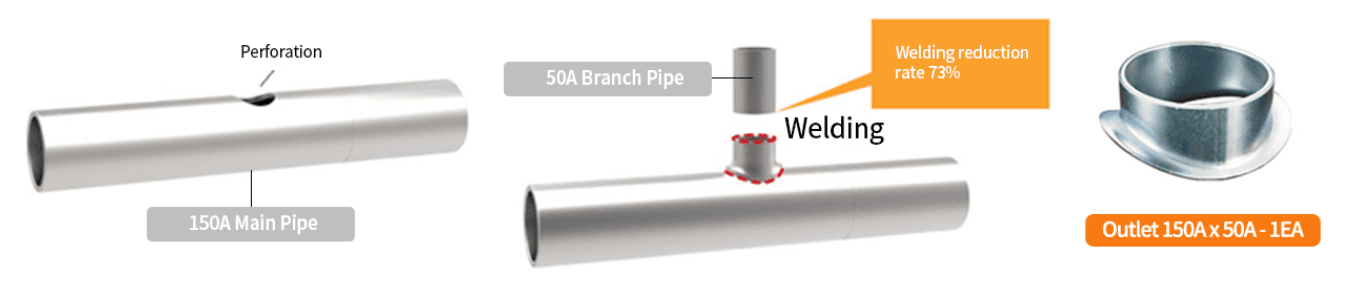
The main pipe is never cut. A hole is drilled, the branch outlet is seated on it and welded. Nothing has to be joined back together, so material, welding and risk all go down together.

What is removed

Nothing has to be cut, so material goes down; there is only one place to join, so welding goes down. Those two together become lower cost and safer installation.

Welded tee against a branch outlet — less material and less welding lead to lower cost and greater safety

Conventional method

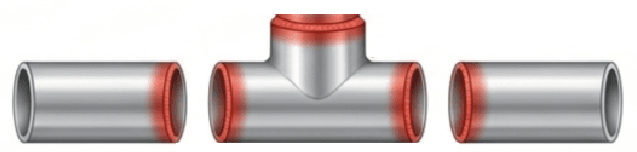
A 150A main pipe is cut in two places and a tee is fitted into the gap and joined. Every cut brings a weld with it.

Conventional method — a 150A main pipe is cut twice and a tee is fitted in and welded

Outlet method

The main pipe is never cut. A hole is drilled, the branch outlet is seated on it and welded once. The main pipe runs unbroken, so the pipe itself stays strong.

Outlet method — the main pipe is not cut; a hole is drilled and the branch outlet is welded on

Outlet installation sequence

Drill → seat the branch outlet → weld. Three steps and it is done. The seating position is fixed, so no eccentricity arises.

Outlet installation sequence — drilling, seating the branch outlet, completed weld

COST SAVING

What is saved against conventional methods

What goes down when a conventional method (welded tee insertion, or a socket and nipple assembly) is replaced by PLS Outlet Fittings.

Conventional welded tee

Conventional method — the main pipe is cut into several lengths and every joint is marked in red as a weld
The main pipe is cut away and a tee is fitted into the gap. Every cut joint has to be welded, and each one needs bevel preparation before welding.

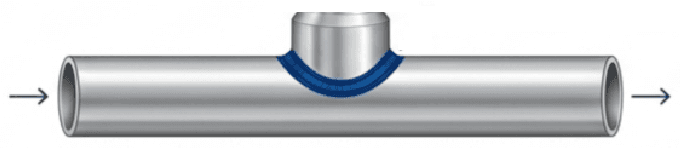
Outlet method

Outlet method — the main pipe runs unbroken and only the branch is marked in blue as a single weld
The main pipe stays whole; only a hole is drilled in its side and the outlet is joined there. Cutting and bevel preparation disappear altogether.

Welded tee insertion

BT · ST Outlet Fittings

The main pipe is cut and a tee is inserted. The outlet method only drills a hole, so cutting, bevel preparation and double-sided welding disappear altogether.

Fitting costLower than a welded tee
Weld points2 points → 1 point
Welding timeReduced
Pipe cuttingNot required
Bevel preparationNot required
Labor costReduced
Construction periodReduced

Socket + nipple assembly

BT-PT · ST-PT (a single part)

Many sites join a socket and a nipple instead of a welded tee. That assembly is replaced by a single BT-PT or ST-PT part.

Number of parts2 parts → 1 part (1 fewer)
Assembly steps1 step fewer
Work timeReduced
Labor costReduced
Leak pointsFewer joints, so fewer points of risk

※ The saving in money depends on your site rates (material and labor). Send us drawings and quantities and we will work it out for that site.

SIDE BY SIDE

Conventional vs PLS

What is used, and how many, to make the same branch. Principle, materials required and the pros and cons are set out side by side in three rows.

ItemPLS outlet methodConventional method
Principle
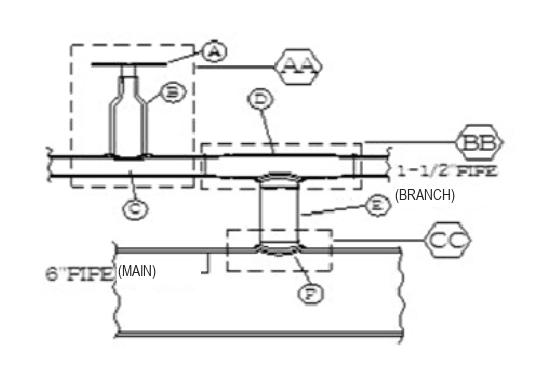
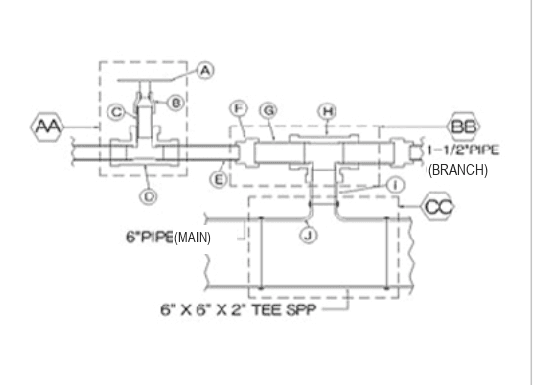
PLS outlet method drawing — the branch line is taken off the side of the main pipe without cutting it
Conventional method drawing — the main pipe is cut, a tee is fitted in, and reducers and nipples are threaded together to form the branch
Materials required
AA
1 × upward outlet
BB
1 × cross-main branch tee
CC
1 × butt weld outlet

Materials 3 items

AA
1 × concentric reducer 25A×15A · 1 × nipple 25A · 1 × tee 40A×40A×25A
BB
1 × threaded tee 50A×50A×50A · 2 × nipple 50A · 2 × concentric reducer 50A×40A
CC
1 × tee 150A×150A×50A

Materials 9 items

Advantages and drawbacks
  • AdvantageCan be fabricated both in the shop and on site
  • AdvantageFewer steps, so productivity goes up
  • AdvantageLess material stored on site and a shorter fabrication period
  • AdvantagePad reinforcement and the weld groove angle give excellent weld strength
  • AdvantageLess weld surface is exposed to the fluid, so corrosion and leakage risk is low
  • AdvantageCold forging gives excellent mechanical properties
  • AdvantageFewer welds and threaded joints lower the cost and raise safety
  • AdvantageWithstands high-temperature and high-pressure conditions well
  • AdvantageThreaded piping makes it easy to adapt to site conditions
  • DrawbackLong construction period with high material and labor costs
  • DrawbackCutting the pipe away wastes material
  • DrawbackThe inside of the weld meets the fluid, so corrosion is more likely
  • DrawbackMany threaded joints mean a high risk of leakage
  • DrawbackSite fabrication means heavy loss of labor whenever the schedule slips

BT VS ST

The same outlet method — what differs

The BT Series is insert-aligned in the main pipe, so eccentricity isremoved and a consistent root gap is formed.

AspectBT — Bevel-prepared Branch Outlet FittingST — Saddle type Branch Outlet Fitting
Branching methodExtruded — inserted into a hole formed by hole flanging the main pipeNon-extruded — a saddle matched to the pipe curvature is seated and joined
AlignmentInsert-aligned in the main pipe — eccentricity is eliminatedSeated on the outer surface — the installer sets the position
RootA consistent root gap forms automaticallyA simple process with shorter weld length and fewer passes
Weld qualityInsertion depth and root gap are fixed, so weld quality is standardizedQuality assured to the KFI approval criteria
Welding timeHigh repeatability cuts the time furtherShorter than a conventional tee
Key advantageWelding variables (welder, site) locked in by geometryCost efficiency · variety of connection types

TECHNOLOGY

BT / ST technology

BT Series — Extruded collar type

Bevel-prepared Branch Outlet Fitting

A branch outlet fitting that is inserted and welded into a hole formed on the side of the main pipe by hole flanging. Welding variables that used to depend on the welder and the site are locked in by the mechanical geometry of the fitting, raising weld quality and the safety of fire-protection piping.

Patents · approvalsPatent No. 10-2328611 · LH New Technology · Registered Item for Public Procurement
Design standardBranch reinforcement design applied — ASME B31.3 Area-Replacement & MSS SP-97 Integrally-Reinforced Branch Outlet Fittings
· Weld-optimized design

A stopper flange sets the insertion depth, eccentricity limit, vertical alignment and root gap automatically as soon as the branch is fitted. Working efficiency improves by more than 50%.

· Reinforced weld strength

The press-fit stopper forms the root gap, and the beveled outer edge secures the torch approach angle and the weld groove angle. Deposited metal and penetration both increase, ensuring high weld strength and uniformity.

· Leak and deformation prevention

Weld metal is kept from entering the pipe, and the gentle inner gradient prevents local loss at the branch. Flow stays smooth and deep cracking is minimized.

· KFI-approved product

Certified by the performance approval testing of the Korea Fire Institute (KFI).
BT-PTBT-SPPTBT-SPPFBT-RNWBT-BWBT-GR

ST Series — Non-extruded type

Saddle type Branch Outlet Fitting

A non-extruded branch outlet fitting: a hole is drilled in the side of the main pipe, and a saddle-shaped fitting matched to the curvature of the pipe surface is seated on it and welded.

Patents · approvalsDesign Registration No. 30-1257230
Design standardConforms to the MSS SP-97 Integrally-Reinforced Branch Outlet Fittings design philosophy
· Cost saving

Markedly lower cost than a conventional tee fitting. Shorter weld lengths and fewer passes simplify the process and raise productivity.

· A wide range of connection types

Butt weld, threaded, grooved, socket and other types are available to suit site conditions.

· KFI-approved product

Certified by the performance approval testing of the Korea Fire Institute (KFI).

ST-PTST-SPPTST-SPPFST-SWST-BWST-GRST-MT(15A)ST-MTNPT(15A)ST-MT(20A)ST-MTNPT(20A)

BT PATENTED TECHNOLOGY

Welding variables locked in by geometry

Welding conditions that used to swing with the welder and the site are fixed by the shape of the part itself.

Patent No. 10-2328611LH New TechnologyRegistered Item for Public Procurement
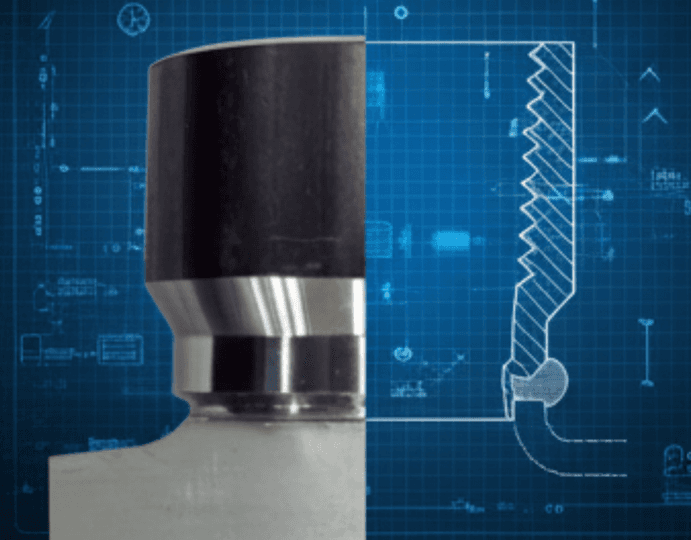
Section through a BT outlet fitting — on the left the cut part itself, on the right a section drawing of the same place
On the left, the actual cut face; on the right, a section drawing of the same place. The numbers match the notes beside it.
Figure — PLS product brochure
  1. Beveled outer edgeBevel Edge Design

    Secures the torch approach angle and weld groove angle → a sufficient penetration path at the root → less incomplete penetration and lack of fusion

  2. Stopper flangeStopper Flange Design

    Stopper flange + press-fit alignment → consistent insertion depth and root gap → repeatable penetration

  3. Press-fit bodyPress-Fit Body

    The body inserted into the main pipe hole melts together during welding to induce full penetration → integral stiffness reinforcement of the extruded collar

  4. Gentle inner gradientInner Gradient Design

    Inserted at the branch entry → less local loss and pressure change → lower risk of sediment and turbulence inside the pipe